
International Markets Outperforming U.S. Markets as of August 6, 2025
After more than a decade of U.S. market dominance, 2025 has marked a dramatic shift in global equity performance. International markets are outpacing U.S. stocks, presenting both opportunities and challenges for portfolio construction and client expectations.
Current Performance: The Numbers Tell the Story 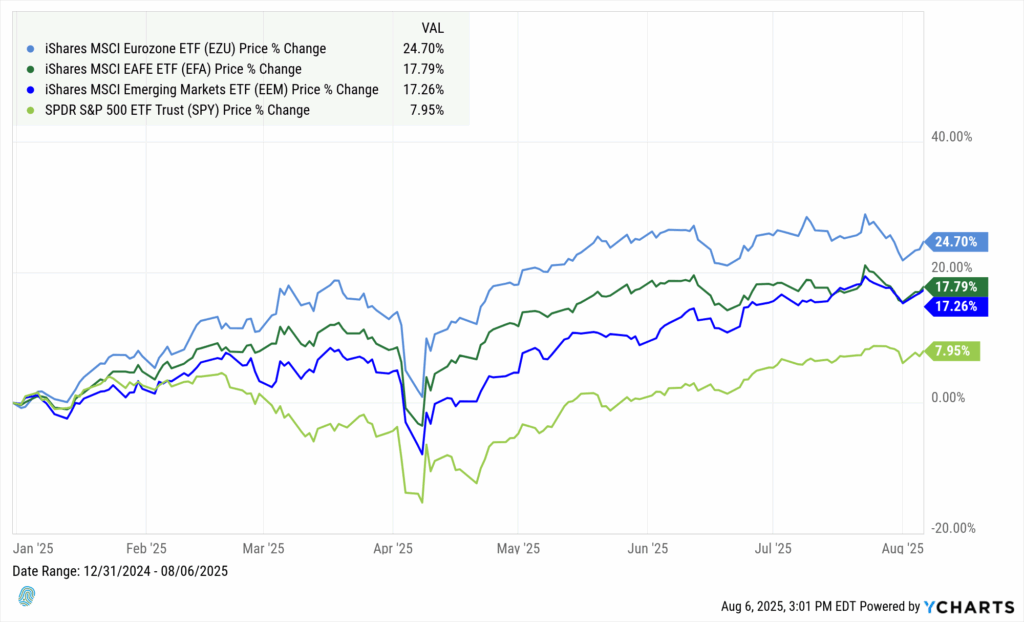
Year-to-date performance data through August 6, 2025, reveals a striking reversal of recent trends. European markets, as measured by the iShares MSCI Eurozone ETF (EZU), have delivered impressive returns of 24.70%, while the MSCI EAFE (developed international markets) has gained 17.79%. Emerging markets, tracked by the EEM ETF, have posted solid returns of 17.26%. In stark contrast, the S&P 500 has managed only 7.95% returns over the same period.
This performance gap is even more pronounced when viewed in the context of recent market volatility. While U.S. markets experienced significant turbulence in April, international markets demonstrated greater resilience and recovery momentum.
Long-Term Performance (2015-2025)

The second chart, spanning August 5, 2015, to August 6, 2025, shows the U.S. outperformance over the past decade. It is essential to understand the magnitude of U.S. outperformance to appreciate the significance of this recent shift in international outperformance. The SPY has achieved a remarkable 199.3% price increase, reflecting the U.S. market’s long-term growth.
However, international markets have closed the gap significantly: EFA at 36.62%, EZU at 50.27%, and EEM at 33.38%. While the U.S. market remains a powerhouse, the relative outperformance of international ETFs in recent years indicates a diversification opportunity. This long-term view suggests that international markets may be entering a phase of catching up, driven by global economic shifts.
Potential Drivers of this Shift
At the end of last year, we observed that the U.S. market was overpriced while the Eurozone was showing a positive trend. The Eurozone has continued this upward trend, offering a consistent risk/return profile. Contributing factors to this situation included poor bond and treasury sales.
It is important to note the differences between the European and U.S. markets. Europe continues to grapple with overregulation, whereas the U.S. is focusing on innovation. It remains challenging to determine whether the recent shift in performance is cyclical or merely a temporary fluctuation. Given the heavy deregulation occurring in the U.S., there could be a more favorable environment for growth in the future.
One of the reasons Europe has underperformed for so long is its slower economic growth compared to the U.S. Following the U.S. election and a change in administration, coupled with the fact that U.S. markets are valued at 2-3 times higher than their European counterparts, international markets became a safe haven for equity allocations as we entered the new year. This shift in allocation has altered market dynamics thus far this year.
When markets have momentum, they attract more capital. However, there is considerable uncertainty regarding how the European economy will navigate tariffs, changes in defense spending, and evolving policies in the coming months. This trend warrants close attention as the year progresses.
Implications for Financial Advisors
The data reveals the importance of international diversification. Clients with heavy U.S. market exposure may benefit from shifting a portion of their portfolios toward international allocations.
After years of U.S. market outperformance, many clients may be surprised by this reversal. Clear communication with your clients regarding the cyclical nature of global market leadership and the advantages of active portfolio management is important.
If you have any questions or recommendations for future posts, please contact mallory@trademarkcapital.com.
Thank you for reading!
This material is intended for informational purposes only and should not be construed as legal, accounting, tax, investment, or other professional advice. Trademark Capital’s investment strategies are built using quantitative, proprietary algorithms that are designed to identify and react to changing market conditions. However, investors should be aware that no investment strategy or risk management technique can guarantee returns or eliminate risk in any given market environment. As with all investments, Trademark Capital Management’s investment strategies are subject to risk and may lose money. The investment strategies presented are not appropriate for every investor and individual clients should review with their financial advisors the terms and conditions and risk involved with specific products or services. Due to our active risk management, our managed portfolios may underperform during bull markets. Past performance is no guarantee of future results.



